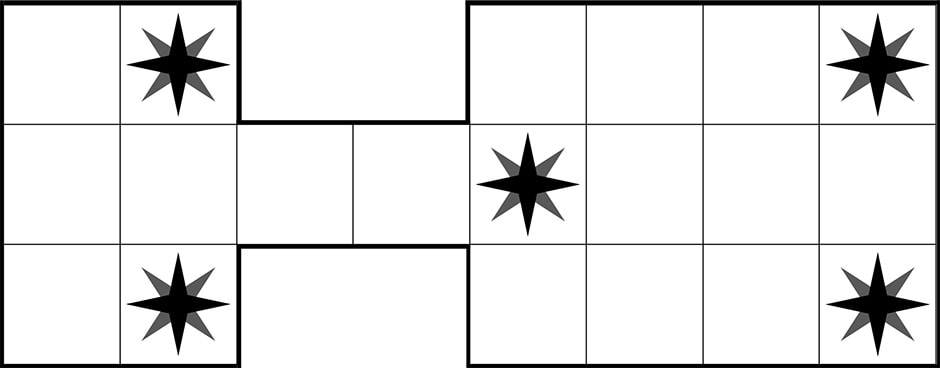
Royal Game of Ur board showing two offset rectangles connected by a bridge

A modern Royal Game of Ur board, with star-shaped rosette squares marking key positions on the track.

Royal Game of Ur Rules

The Royal Game of Ur is an ancient race game from Mesopotamia. Its exact rules were never written down, so modern versions are reconstructed from boards, pieces, and historical references. Despite the mystery, most modern rule sets agree on the same core: a shared path, racing counters, and special "rosette" squares that can swing the game.

Ancient Mesopotamian game Two-player race game Binary pyramid dice Multiple modern variants

Board, counters, and dice

The board consists of twenty squares arranged as two offset rectangles connected by a central "bridge" of shared squares. Five squares are marked with a star-like symbol, called rosettes. These are special safe squares that usually grant a bonus.

Each player has seven counters, typically one set dark and one set light. Both players use the same track but enter, move, and bear off their own counters.

Three four-sided pyramid dice are used. Each die has two marked vertices and two unmarked ones. On a roll, each die showing a marked corner counts as one point. If all dice are unmarked, the total is treated as four instead of zero.

Quick setup checklist

  • Place the board between the players so that both can clearly see the central shared track.
  • Give each player seven matching counters; keep all counters off the board at the start.
  • Use three pyramid dice and agree that a total of zero counts as four.

Both players roll; the higher total takes the first turn with those dice.

Royal Game of Ur board marked with the typical sixteen-square track followed by each colour

A common reconstruction of the Ur track: both players follow symmetrical sixteen-square paths before bearing off.

The path through the board

The most widely used modern version has a sixteen-square path for each player. Both colours enter on their own starting square, run along the shared bridge, then exit through their own finishing section.

The objective is to move each of your seven counters onto the track, along the path, and then off the board. The first player to bear off all seven counters wins.

Taking turns and moving counters

On your turn you roll the three dice, total the result, and then either enter a new counter or move a counter already on the track that many squares along your path.

  • If all of your counters are off the board, you must use the roll to enter a counter onto the track by counting the rolled number of squares from your start.
  • Once you have pieces in play, you may either bring a new counter onto the board or move one already on the path by exactly the rolled number of squares.
  • You may not move a counter onto a square already occupied by one of your own counters.
  • You may not move onto a rosette square that is currently occupied by an opponent’s counter.
  • You may move onto any other square occupied by an opponent’s counter; their counter is then evicted from the board and must start again from off-board.

If none of your counters can move legally with the number rolled, you simply lose your turn and your opponent rolls.

Rosettes and bearing off

Rosette squares add tension and tempo swings to the game.

  • Safe squares: a counter on a rosette cannot be captured. Opponents may not land on that rosette.
  • Extra throw: whenever you land a counter on a rosette by exact count, you immediately take another turn with a fresh roll.
  • Key chokepoints: because rosettes are safe and often lie on the shared central track, control of them is strategically important.

To leave the board, a counter must reach beyond the final square by an exact roll. For example, a counter on the last square must roll exactly one to be borne off. The first player to bear off all seven counters wins the game.

Rule variations

The Royal Game of Ur survived mainly as boards, pieces, and scattered references, so several modern scholars and institutions have proposed slightly different rule sets.

The core ideas remain the same: a race along a fixed path, captures, safe rosettes, and exact rolls to bear off. The differences mostly affect path length, dice, and pacing.

Three notable modern variants

  • H. J. R. Murray: extends the path into a longer loop around the board before bearing off.
  • British Museum: adjusts the equipment and shortens the track for faster games.
  • R. C. Bell: modifies dice outcomes and adds a betting element.

H. J. R. Murray variant

In Murray’s reconstruction, the conventional path is extended into a loop. From the end of the standard track, a counter continues back inside and across the bridge, retracing its route towards the first square before finally bearing off.

A total of 27 squares are traversed, with the 28th move taking the piece off the board. Apart from the longer path, the familiar rules for entry, capture, rosettes, and exact rolls still apply.

British Museum variant

The British Museum popularised a streamlined version in the 1990s, aiming for shorter, more approachable games.

  • An extra die is used. A roll of four counts as four, and a roll of zero is simply a null turn (no move).
  • Each player uses five counters instead of seven, reducing the total traffic on the board.

The path runs through eleven squares on the shared track and then extends one more square to the edge before rejoining the original route, giving a 14-square track plus a 15th move to bear off.

R. C. Bell variant

R. C. Bell’s rules, later adapted by the British Museum, keep the shorter path but radically alter how the dice are interpreted, changing the tempo and risk profile of the game.

Bell’s dice outcomes
  • Roll of 0: move a counter four squares and take an additional throw.
  • Roll of 1: null turn; you make no move.
  • Roll of 2: move a counter one square and take an additional throw.
  • Roll of 3: move a counter five squares and take an additional throw.
Betting and entry rules

Bell also introduces a simple betting system with a central kitty that grows as the game progresses.

  • Each player contributes a fixed sum to the kitty at the start of the game.
  • Whenever a player lands a counter on a rosette, they pay a fixed fine into the kitty.
  • The winner of the game takes the entire kitty.

In this variant, a counter may enter the board only on a roll of three, immediately moving onto the fifth square of the track.

Experimenting with Ur

Because the original rules are not fully preserved, the Royal Game of Ur is an ideal candidate for house rules. Once you understand a standard version, you can borrow ideas from Murray, the British Museum, and Bell, or even replace the pyramid dice with coin flips or other binary randomisers to tune the pace and feel of the game.

Our unique tool uses AI to show you chess sets that are right for you.

Describe what you're looking for...

Try: Staunton set for 50 cm board Luxury gift under £200
Press ENTER to search.